





When specifying a flat roof, waterproofing and insulation usually receive most of the attention. But beneath the insulation sits another critical component: the vapour control layer (VCL).
Once installed, it disappears from view – but selecting or installing the wrong VCL can contribute to condensation, wet insulation and reduced thermal performance.
For architects, specifiers and contractors, the VCL should therefore be considered as part of the complete roof design, not simply another layer in the build-up.
What Does a VCL Actually Do?
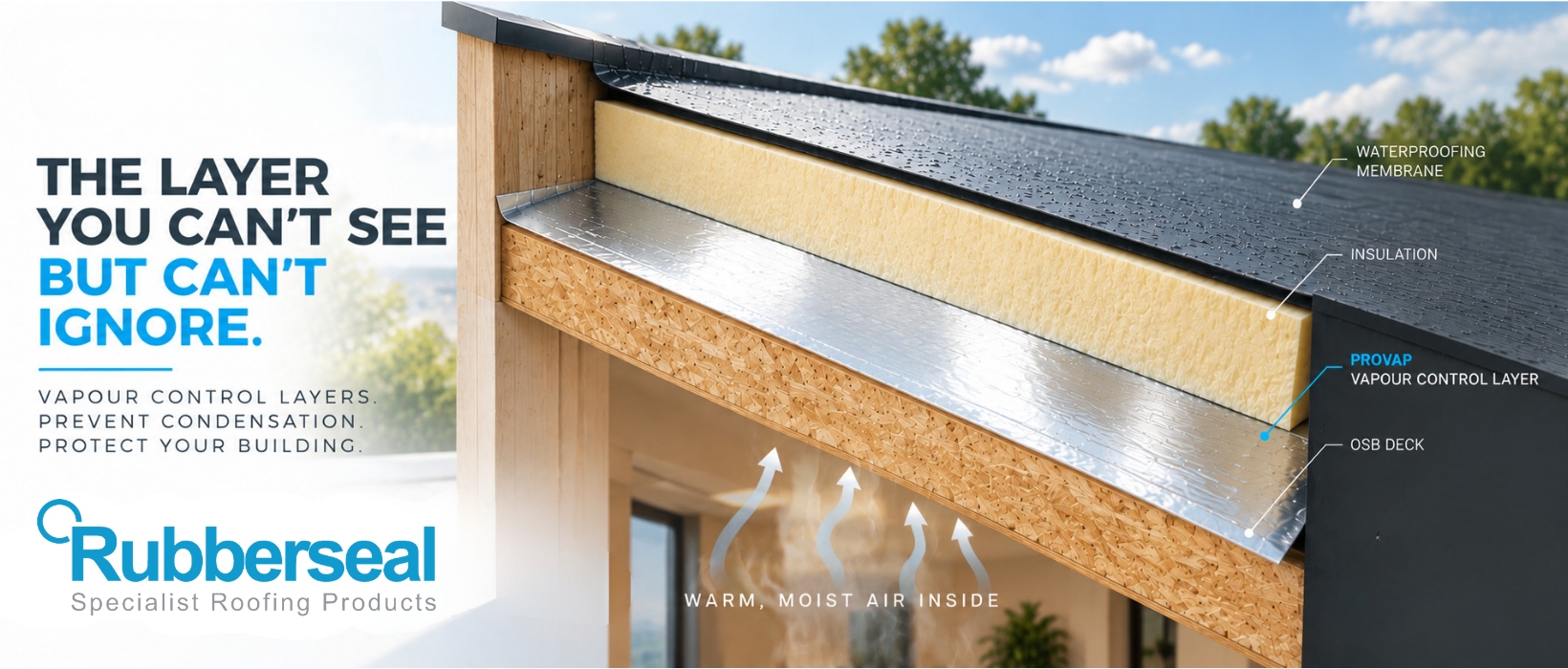
Warm, moisture-laden air inside a building naturally moves towards colder areas of the building fabric.
As it travels through a roof construction and cools, there is a risk of interstitial condensation occurring within the roof build-up.
A VCL is installed on the warm side of the insulation to restrict this movement of water vapour.
A typical warm flat roof build-up is from top to bottom:
Waterproofing → Insulation → VCL → Structural Deck
Without appropriate vapour control, moisture entering the roof construction can potentially lead to wet insulation, reduced thermal performance, corrosion and deterioration of moisture-sensitive materials.
Not Every Building Needs the Same VCL
This is where specification becomes important.
The amount of moisture generated inside a building can vary enormously.
An office or dry warehouse, for example, presents very different conditions from a:
- Swimming pool
- Commercial kitchen
- Sports or leisure facility
- Changing room
- Food-processing facility
- Building containing wet industrial processes
Higher internal humidity can place much greater demands on the roof construction.
VCL selection should therefore consider the building use, internal conditions, insulation, structural deck and complete roof build-up, with condensation risk analysis undertaken where required.
Continuity Matters Just as Much as the Membrane
A high-performance VCL can still be compromised by poor detailing.
The membrane needs to remain continuous at laps, rooflights, upstands, parapets, outlets and service penetrations.
This is particularly important where pipes, ducts and other services pass through the roof.
Substrate preparation matters too. Self-adhesive VCLs rely on effective adhesion, meaning surfaces need to be suitably prepared and the correct primer used where required.
Once the insulation has been installed, accessing the VCL to correct these details becomes considerably more difficult.
Choosing the Right VCL
Rubberseal’s ProVap range provides several VCL options because different roof constructions have different requirements.
ProVap S/A
ProVap S/A is a self-adhesive bituminous vapour control membrane incorporating composite aluminium foil reinforced with an integral glass-fibre mat.
Its exceptionally high vapour resistance makes it particularly relevant to buildings with demanding internal humidity conditions, including swimming pools, sports halls, changing facilities and commercial kitchens.
It can be installed over concrete, plywood/OSB and metal decks and is cold applied without the need for a naked flame.
Another useful feature is its ability to provide temporary waterproofing to the roof structure before the insulation and final waterproofing are installed.
ProVap Stik
ProVap Stik uses reinforced aluminium foil with a self-adhesive backing and is designed for steel and timber decks.
Its reinforcement provides additional mechanical resistance, helping protect the membrane against damage and foot traffic when spanning the corrugation valleys of lightweight steel decks.
There’s also an important specification distinction: ProVap Stik is intended for mechanically attached or loose-laid insulation and should not be used where insulation boards are being adhered to the VCL.
It’s a good example of why the insulation attachment method needs to be known before the VCL is selected.
ProVap Sand S/A
ProVap Sand S/A performs two functions: it can act as a vapour control layer and a liquid roofing carrier membrane.
The self-adhering composite membrane incorporates an SBS polymer-modified bitumen compound with fibre reinforcement and a granulated anti-slip upper surface.
Installed in conjunction with ProVap SA Primer, it provides another cold-applied, flame-free solution and can be installed over concrete, plywood/OSB and metal decks.
ProVap TR
ProVap TR is a lightweight reinforced LDPE vapour barrier incorporating woven polyethylene reinforcement for resistance to tearing and puncturing.
Unlike the other products above, it can be used within both roof and wall constructions.
An interesting additional feature is its 81% light transmission, and it can also be used temporarily to cover building openings or form dust walls during construction.
Don’t Choose a VCL in Isolation
Before specifying a vapour control layer, consider the complete roof:
What is the building used for? What are the expected internal humidity conditions? What is the deck? How will the insulation be fixed? What level of vapour resistance is required? How will penetrations be sealed? And has condensation risk been considered?
The answers can significantly influence which VCL is appropriate.
This becomes even more important during flat roof refurbishment, where existing insulation, waterproofing, trapped moisture and previous roof layers can all affect the proposed new construction.
Get the Roof Build-Up Right From the Start
A VCL may be hidden once a flat roof is completed, but its role shouldn’t be overlooked.
Correct product selection, condensation assessment, substrate preparation and – critically – continuity at laps and details all contribute to the performance of the completed roof.
Rubberseal works with architects, specifiers and roofing contractors to provide technical support with VCL selection and complete flat roof build-ups.
Need help specifying the correct vapour control layer? Speak to the Rubberseal technical team about your project.